The Situation
Most of the calls we get about a door that reverses for no reason, or won't close at all, come down to the two small sensors near the bottom of the track. They're supposed to sit a few inches off the floor, aimed dead at each other, and if anything breaks that beam the door stops. In a lot of the houses we work on - around McKinley Park, Brighton Park, Little Village, Bridgeport - the garage wasn't built with those sensors in mind at all. Housing in this service area runs 1938 to 1994, with a lot of it clustered in the 1960s and 70s, and photo-eye sensors weren't standard equipment on openers until well after that. So the sensor setup you have now is often a retrofit, mounted onto brackets that were added decades after the door and slab went in. That matters because a retrofit bracket is only as stable as whatever it's screwed into, and in a lot of these garages that's old concrete, a warped wood jamb, or a metal track that's been re-hung once or twice already. None of that is a defect exactly - it's just what happens when equipment from the 2000s gets bolted onto a building from 1964.
Checking It Yourself
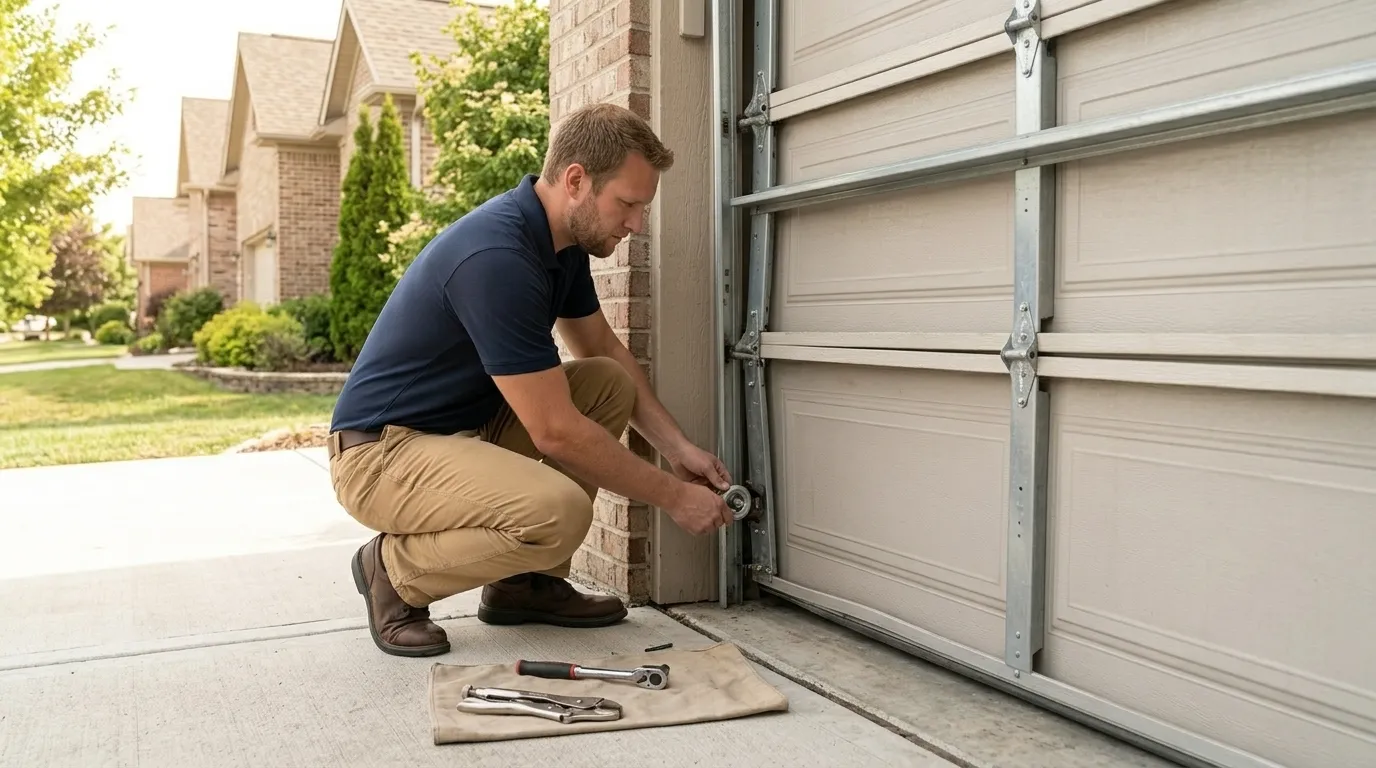
Before you call anyone, look at the two sensor eyes yourself. They should be at the same height on both sides of the door, usually 4 to 6 inches off the floor, and the small indicator light on each one should be lit steady, not blinking. A blinking light on one side usually means it's not receiving the beam from the other - check for anything blocking the path first, including a spider web or a leaf, which happens more than you'd think in an older detached garage. If the path is clear, try gently loosening the wing nut on each bracket and nudging the sensor a fraction of an inch, then retighten and test the door. If the bracket itself is loose in the wall or the wood around it is soft, that's a sign the mounting point has degraded, which is common in garages from the 1938-1964 era where the framing has had sixty-plus winters to work on it. Don't force anything metal or pry on the wiring - the connections at these sensors are low-voltage but not built for repeated bending.
When to Call Someone
If you've checked alignment and cleared the path and the door still won't respond, or the sensor light won't come on at all, that's usually a wiring problem rather than an aiming problem, and it's not always a quick fix in an older garage where the wire run is buried in the wall or was added as an afterthought. We won't guess at wiring without seeing it - tracing a bad run in a 1960s garage can mean opening up part of a wall, and that's a different conversation than a five-minute realignment. One honest limit here: if your bracket keeps drifting every season no matter how many times it's reset, replacing the bracket mount is usually cheaper in the long run than us coming back every spring to nudge it again. We can tell you which one you're dealing with once we're standing in front of it.